

Become a Cocoa Grower
Our cocoa growers are the heart and soul of Daintree Estates chocolate, and always will be.
If you’re looking to diversify your farming, consider cocoa. Not only is chocolate made from it, but cocoa is recognised as a superfood, loaded with nutrients, essential minerals and powerful antioxidants.
Currently there’s only around 20-25 hectares of cocoa growing commercially in Australia. That’s not even enough to keep up with domestic demand for Australian origin chocolate, let alone contemplate exporting around the world. Our local cocoa industry is still at a very early-stage and the opportunities are huge.
Today there is a new wave of forward-thinking farmers investing in cocoa for a better future, and as the pioneer of Australian origin chocolate, Daintree Estates remains committed to nurturing and supporting Australian cocoa growers.
If you're interested in growing cocoa, we’d love to hear from you.
Location
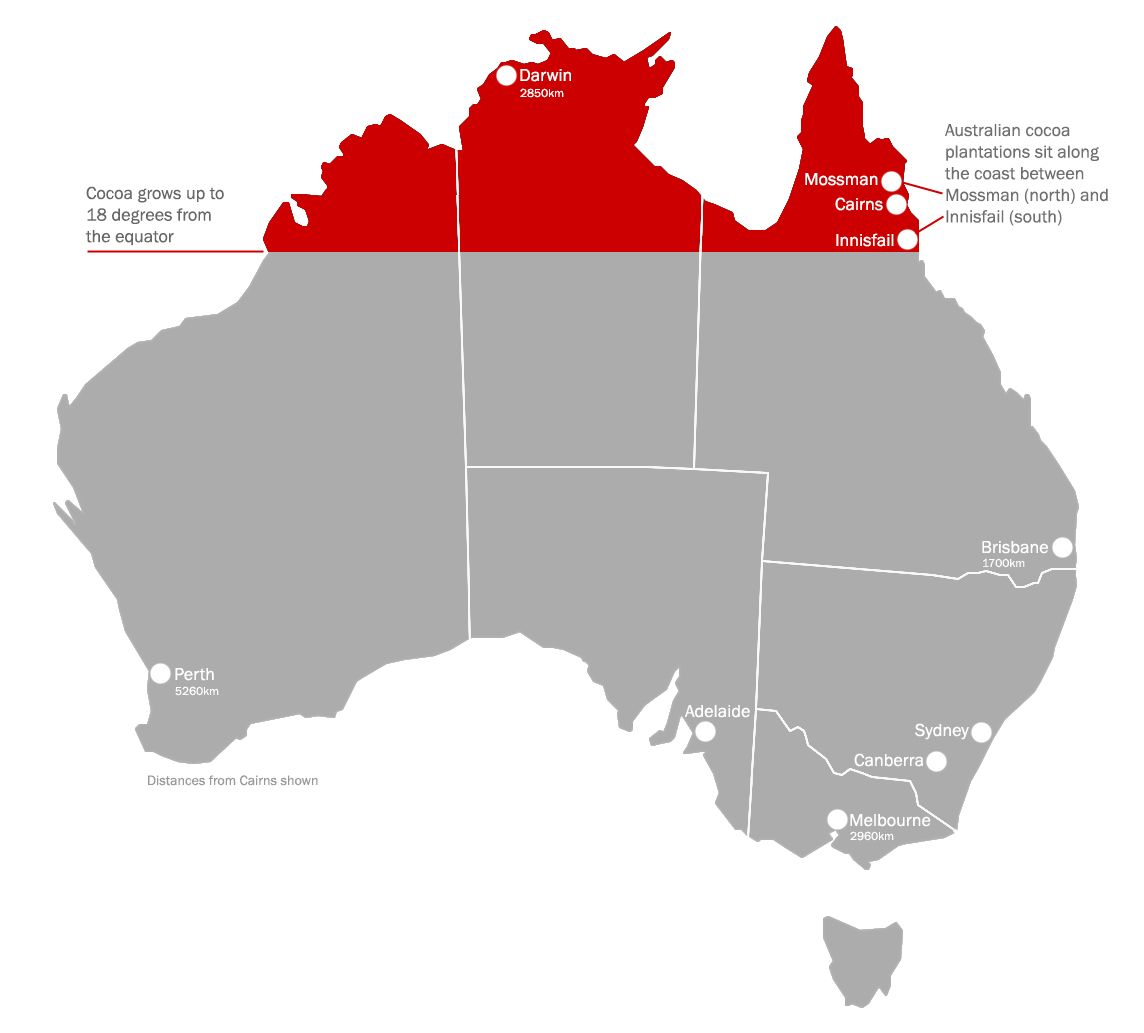
Cocoa is grown commercially in Australia along the Eastern coast of Queensland between Mossman and Innisfail, and up into the Atherton Tablelands with a few plantations further out. This region has excellent road and services infrastructure, ready access to transport providers and hubs, staff and labourers, and is well supported by state and local government.
Cocoa plantation performance and flavour profile varies depending on the topography, elevation and regional microclimate where it is grown. Collectively these are referred to as 'terroir' which is a key indicator to consumers of the taste profile of chocolate or cocoa products.
Requirements
The Queensland Department of Primary Industries was a key participant in Australia’s first cocoa trials between 1998-2013 as part of the Northern Australia Cocoa Development Alliance (NACDA) and has good knowledge and resources for establishing and managing cocoa plantations.
The basic requirements to grow cocoa commercially are…
- Cocoa seedlings
Cocoa seedlings are not readily available from commercial nurseries, and certainly not at fair bulk prices. Most farmers create their own temporary nursery to propagate new cocoa seedlings from seeds taken from freshly harvested ripe pods. Speak with us about sources of good cocoa seed stock. You’ll need around 1000 seedlings per hectare. Small cocoa seedlings can be transferred to larger pots for 3-6 months so they are hardened and ready to plant.
- Land preparation
Soil testing is required to ensure it’s suitable for cocoa. As cocoa doesn’t like wind or excessive sun, choose a site which is protected from winds and preferably in natural shade for some parts of the day. Rapid growing shade trees can be planted first to give the cocoa seedlings some protection from harsh and excessive sun as they’re getting established, but might need to be removed once the cocoa trees are fully established. Encircling each seedling with shadecloth is recommended for the best protection whilst they’re young.
- Water & nutrients
Cocoa needs plenty of water. Natural rainfall will suffice for the wetter months, but during the drier months, you will need irrigation from a reliable water source such as a creek or bore (approvals required). Your irrigation system can be automated with ground detectors which will reduce wastage. Consider automated fertigation to deliver optimal nutrients to the cocoa trees.
- Plantation husbandry
For the first 2 years, the cocoa seedlings will require special care and attention including good nutrients, water, protection from weeds and insect pests. By the third year, the seedlings will require careful pruning and shaping to ensure they are productive by the following year, and to make harvesting pods as easy as possible. As trees mature, different nutrient regimes will be required as well as additional action against weeds and pests. Pruning and shaping the cocoa trees will be an ongoing routine.
- Harvesting ripe cocoa pods
You may get some ripe cocoa pods by year 3, but it will be year 4 or 5 before you’ll start seeing substantial harvests. Cocoa trees naturally flower all year round, so cocoa pods will ripen all year too, however there are two main bursts, one in April to June and another in September to December. Ripe cocoa pods must be split and the seeds extracted within 5-7 days of harvesting. Most farmers are doing this on their own property, but as scale builds in the industry, centralised cocoa processing facilities will be far more efficient and eliminate this process for growers.
Budget guidance
A 1 hectare cocoa plantation typically costs around $25,000 to set up, including soil testing, ground preparation, shade cloth, stakes, fungicides, seedlings and irrigation setup.
The irrigation setup costs (pump, bore, pipes, solenoids etc) are the biggest costs, however the larger the area, the more cost-effective it will be. The costs to set up a 5 hectare cocoa plantation is not 5 times the cost of 1 hectare, it’s more like 3 times the cost.
Just one competent full-time manager is required to run a 5 hectare cocoa plantation provided they have access to basic machinery such as a quad bike, sprayers and trailer. Casual or part time labour will be required for pruning and harvesting.
Annual harvest yields are influenced by a range of factors, but in Australia, well managed cocoa plantations are achieving up to 3 tonnes of dried cocoa beans per hectare each year.
Grower Resources
Request copies of the following documents which provide in-depth information about establishing and managing a cocoa plantation in Australia.
- 2009 QDPIF Cocoa Growers Handbook
- 2010 NACDA Australian Cocoa Trial Report 1
- 2011 ACIAR Cocoa Pest & Disease Management
- 2013 NACDA Australian Ccocoa Trial Report 2
Have questions?


